
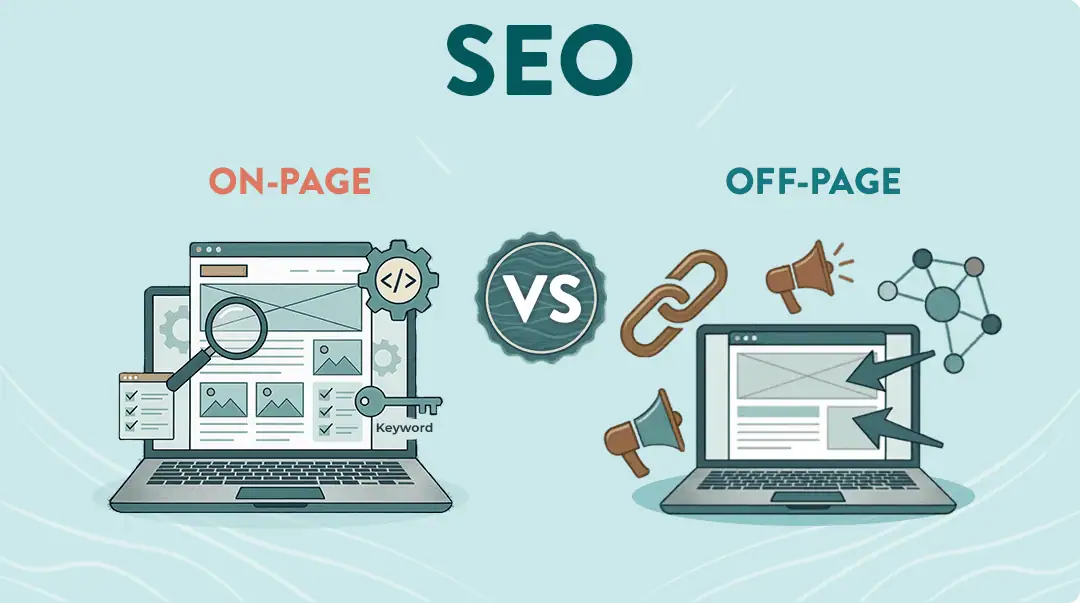
On-Page vs. Off-Page SEO – An Easy Guide for Non-Techie Humans
If the phrase “off-page SEO” makes your eyes glaze over just a teeny tiny bit, hi. I see you.
You started a business to do the thing you love. Bake the cakes. Sell the products. Teach the yoga. Help the people. Not to spend your evenings wondering what search engines want from you this week!
And yet…here you are. Googling SEO things. Feeling like everyone else somehow got a secret handbook that you missed.
Totally normal, my friend.
In this post, I’ll explain what SEO actually is, what people mean when they talk about on-page vs. off-page SEO, and why you really do need both if you want your website to be found by the right folks.
Don’t worry. This isn’t a guide for techie people that will make you feel even more confused than when you arrived.
Grab your beverage of choice, and let’s get into it!
First, I Want You to Know How Search Engine Rankings Work
Let’s start with the big picture.
SEO stands for search engine optimization, which is a fancy way of saying, “helping your website get found when someone types something into Google.”
Search engines are basically giant matchmakers. Someone searches for something, and the search engine tries to serve up the best possible web page for that query on the search engine results pages (SERPs).
Your job? Help search engines understand what your site is about so they can show it to the right people at the right time.
When your site is set up in a way that search engines understand, you’re more likely to show up in search engine results, which means more chances for your website to bring in more relevant traffic from humans who actually want what you offer.
Sounds dreamy, right?
Now let’s talk about the two main buckets of SEO: “on-page SEO” and “off-page SEO”.
On-Page SEO Refers to What’s Happening ON Your Website
On-page SEO focuses on how each of your individual web pages is written, structured, and set up so search engines can understand what that page is about and who it’s meant to help.
In other words: this is the stuff you do on your site to make it easier for your pages to show up in search results.
This includes things like:
- The actual words you use on each web page
- How clear and helpful your headings are
- Whether your content quality is genuinely useful (or just there to fill space)
- How your pages are laid out and structured so they’re easy to read and scan
- How your internal links guide people from one page to another
Things You Can Do to Improve On-Page SEO
- Use relevant keywords in your content in a natural, non-weird way
- Write helpful, clear content for individual web pages
- Add thoughtful title tags and meta descriptions (the little preview text people see in Google before they click) so people know what your page is about when they see it in search engine results
- Structure your pages with clear headings so readers can easily scan and find what they need
- Create internal links so visitors (and search engines) can explore related pages on your site
- Pay attention to keyword optimization without turning your writing into something that sounds robotic or forced.
You can also peek at tools like Google Search Console to see how your pages are performing and which content is getting seen (or ignored), which can be really helpful when deciding what to tweak next.
I always insist that my clients work with a professional copywriter to make sure all of the above meets best practices.
Quick PSA About Technical SEO Before We Keep Rolling…
If your website takes forever to load, acts or looks weird on phones, or sends people to broken pages, it kind of doesn’t matter how lovely your words are. People get cranky fast on the internet. A little behind-the-scenes tidying goes a long way toward making your site feel easy and welcoming instead of “ugh, nope.”
That behind-the-scenes stuff is what we refer to as “technical SEO” (all covered in my website maintenance plan). Here are a few simple ways to give your site a little love:
- Make sure your website loads quickly
- Check that your site works nicely on phones and tablets
- Fix broken links so visitors don’t keep hitting dead ends
- Keep your website software and plugins up to date
- Make sure your pages can actually be found and read by Google
- Tidy up messy page structures that make your site feel confusing to move through
Okay, sidenote over. Now onto our dear friend, off-page SEO.
Off-Page SEO Refers to What Happens AWAY From Your Site
Off-page SEO is less about what you write on your own website and more about how others talk about and link to your site on the internet. Think of this like word-of-mouth for the online world.
This includes things like:
- Other websites linking to your site because they found your content helpful
- Getting mentioned in blog posts, directories, or roundups that make sense for your business
- Being featured on podcasts, interviews, or guest posts (hello, new eyeballs!)
- People sharing your website or content on social media
- Online reviews, shoutouts, or referrals that point folks back to your site
The big idea with off-page optimization is trust. When other relevant, trustworthy sites point people in your direction, search engines take that as a signal that your site is probably worth showing in search results too.
Things You Can Do to Improve Off-Page SEO
You don’t need to spam the internet with your links (please don’t). Instead, try:
- Building genuine relationships with other business owners
- Getting featured in blogs or directories that fit your niche
- Sharing helpful content that people actually want to link to
- Encouraging happy clients to mention or share your site
- Creating content so useful that people naturally reference it
All of this helps drive relevant traffic from places beyond your own website.
On-Page vs. Off-Page SEO in a Nutshell
Basically, on-page SEO helps search engines understand your content. Off-page SEO helps search engines trust your content.
Both play different roles, and both are important.
If you skip on-page SEO, the right people don’t realize the site is meant for them. They scroll a bit, click around, and still don’t know what you do or who you help. That usually leads to “I’ll come back later” energy (but they probably never will).
If you skip off-page SEO, your site can feel like a lovely little island that hardly anyone ever visits. When you put care into both, your website becomes easier to find and easier to use, which is exactly what you want for your business.
One Little Thing I’ll Say Before You Go…
SEO works best when it’s part of the plan from the start, not something you try to bolt on later. When I design and build websites, I always keep those SEO foundations in mind so your site has a much better chance of being found right out of the gate.
If you’re dreaming about a new website and want to do it in a way that supports being found from the get-go, I’m here. Reach out, and let’s chat!
Like this article? Click the icon(s) below to share it with others who may benefit from it:

